Scandlines Begins Operating New Shore Power Connection in Puttgarden
Scandlines has reached another important milestone on the path to low-emission ferry service. The new shore power connection at the Port of Puttgarden is now operational. This means that the company’s Ferries can now be charged with electricity both in Puttgarden and in Rødby, Denmark.
The new battery-powered ferry “The Baltic Whale” stands to benefit most from the new charging infrastructure. At the same time, Scandlines is laying the groundwork to enable electric charging for additional Ferries on the route in the future.
11 kilometers of new power lines to the port
Extensive construction work was required before the new shore power connection could be put into use. A total of about 11 kilometers of power cable was laid from the substation in Burg to the Puttgarden ferry terminal. As a result, the port now has a connection capacity of 15 megawatts.
After all work was completed, the new loading tower was successfully tested and is now ready for regular operation.
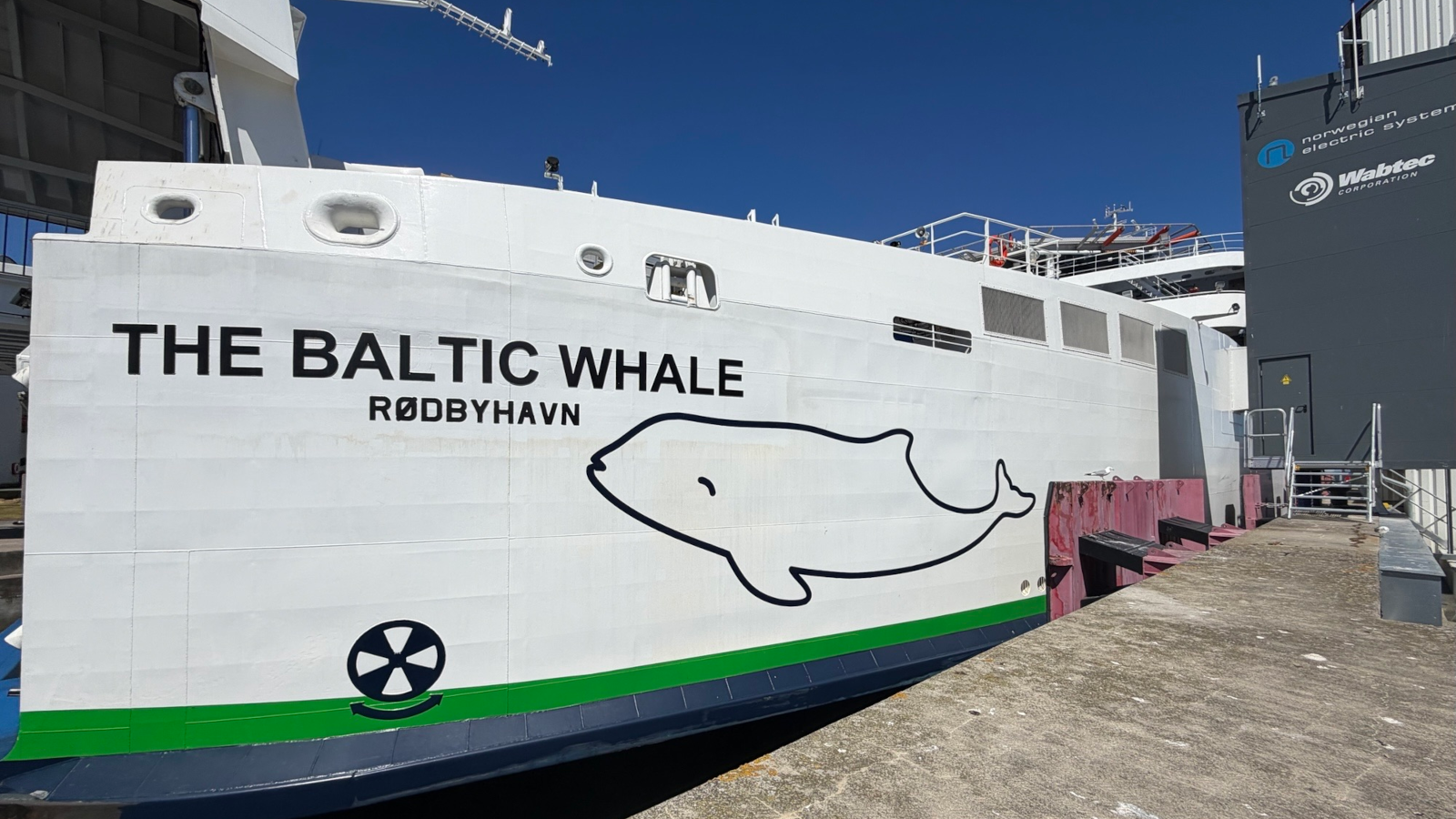
The Scandlines electric ferry, *The Baltic Whale*, at the shore power connection in Puttgarden
Now open on both sides of the Fehmarn Belt
A similar shore power connection has been available at the Danish port of Rødby since March. Now, Ferries on both sides of the Fehmarn Belt can be charged.
This reduces the loading time to just 12 to 15 minutes per port. That is roughly the same amount of time the ship would need anyway during its port call.
The new infrastructure enables significantly more efficient operation of the new cargo ferry “The Baltic Whale, “ which can complete its crossings entirely on battery power during normal operations.
More Departures on “The Baltic Whale”
According to Scandlines, the new battery-powered ferry can now operate on a permanent two-hour schedule. The crossing between Puttgarden and Rødby continues to take about 45 minutes.
Michael Guldmann Petersen, COO of Scandlines, explains that the Ferry has operated on both two- and three-hour schedules to date. Thanks to the loading infrastructure on both sides, the schedule can now be made more frequent on a permanent basis.
For freight transport in particular, this means greater flexibility and additional capacity.

The Scandlines electric ferry, The Baltic Whale, shortly before docking in Puttgarden with its bow door open.
Passenger ferries are also being retrofitted
The new charging station is not intended exclusively for “The Baltic Whale.” Scandlines also plans to supply shore power to the four passenger ferries on the Puttgarden–Rødby route in the future.
Two of the Ferries are scheduled to be converted into modern plug-in hybrid Ferries as early as this year.
Once the retrofits are complete, Scandlines expects that approximately 80 percent of these ships’ energy needs will be met by shore power in the future. This will significantly reduce fuel consumption while also lowering CO₂ emissions.
Major Investments in a Sustainable Future
Since 2013, Scandlines has invested approximately 430 million euros in new technologies. These include, among other things:
- the new battery-powered ferry “The Baltic Whale”
- the retrofitting of existing Ferries with hybrid propulsion systems
- Rotor sails to save fuel on the Rostock-Gedser route
- energy-efficient propellers
- Shore Power Systems in Puttgarden and Rødby
The investment in the shore power connection in Puttgarden was partially co-financed by the European Union through the Connecting Europe Facility (CEF) funding program.
Scandlines Continues to Drive Electrification Forward
With the new shore power connection, Scandlines is laying an important foundation for the continued retrofitting of its fleet. The combination of battery-powered ferries, plug-in hybrid ships, and modern charging infrastructure brings the shipping company closer to its goal of gradually operating ferry service on the Fehmarn Belt without direct emissions.